
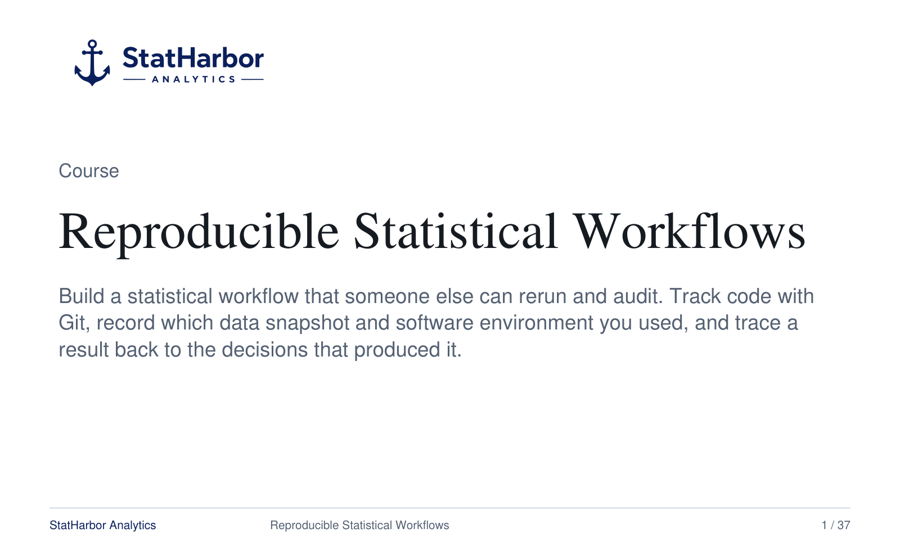
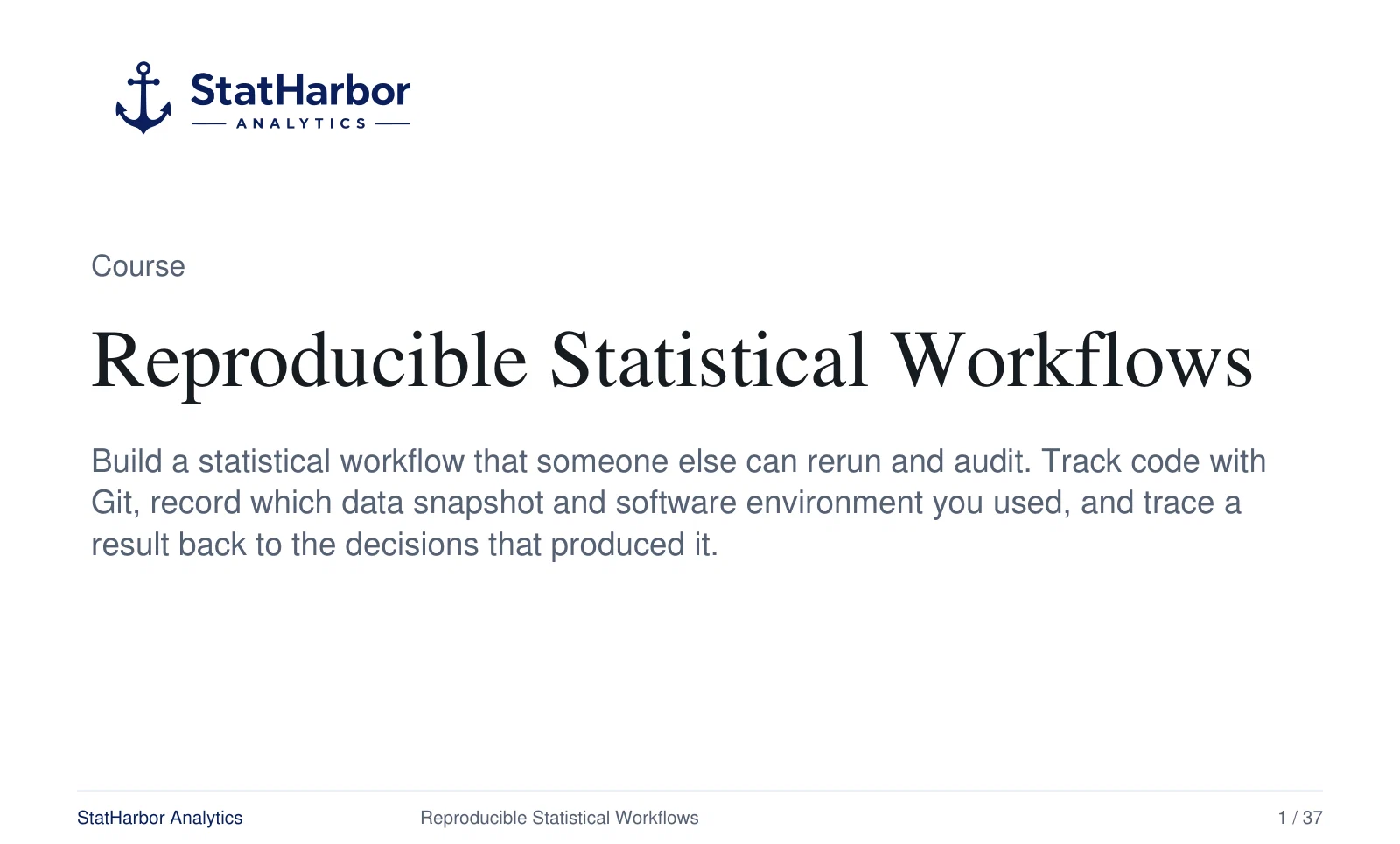
Reproducible Statistical Workflows
Build a statistical workflow that someone else can rerun and audit. Track code with Git, record which data snapshot and software environment you used, and trace a result back to the decisions that produced it.
No account needed to read online.
What it covers
- Version control for everyday statistical work
- Traceable data wrangling and documented data snapshots
- Analysis and modeling that can be reviewed and rerun
- Diagnose drifting results and undo changes safely
- Rebuild tables and figures from a recorded environment
English edition · 37 slides
Can a colleague reproduce your result?
Estimate event risk at the earliest recorded visit among people with a known outcome. The archived run found one event among three people. Choose a change and predict what a rerun will show.
Reveal the answer and interpretation
Trace A’s visits. Day 1 has no event and day 3 has an event. Reversing the file changes which visit appears first. Sort each person’s visits by day and select the earliest. Both files then give 1 event among 3 known outcomes.
The archive reports 1/3. The rerun reports 2/3.
Both scripts keep the first row they encounter for each person with a known outcome. The study asks for the earliest visit. Inspect the two files in their supplied order.
Archived file
| ID | Visit day | Event |
|---|---|---|
| A | 1 | 0 |
| A | 3 | 1 |
| B | 1 | 0 |
| C | 1 | 1 |
| D | 1 | Unknown |
Rerun file
| ID | Visit day | Event |
|---|---|---|
| D | 1 | Unknown |
| C | 1 | 1 |
| B | 1 | 0 |
| A | 3 | 1 |
| A | 1 | 0 |
Read online
Reproducible Statistical Workflows
Your last page is remembered in this browser. Use zoom and swipe within the page to inspect equations.
Request access
Reading online is free. You can request a PDF copy or companion files here. StatHarbor Analytics reviews requests privately.
Sign in with ChatGPTDiscussion
Questions, clarifications and applications of this resource.
Loading discussion…